Open-Loop vs. Closed-Loop 3D Printing: What's the Difference and Why It Matters
Every FFF 3D printer executes the same basic sequence: it reads G-code instructions, heats a nozzle, and deposits material layer by layer. But what happens when something goes wrong mid-print? The answer to that question separates two fundamentally different approaches to process control — and determines whether FFF can meet the demands of industrial manufacturing.
How Open-Loop Printing Works
The vast majority of FFF 3D printers on the market today operate in open-loop mode. The system receives a set of G-code instructions generated by a slicer, and the printer executes them sequentially. The firmware commands stepper motors to move to specified coordinates, sets heater temperatures to target values, and drives the extruder at a calculated feed rate.
At no point does the system verify whether the commanded actions produced the intended result. The printer assumes that if it told the nozzle to move to position X=150, Y=200 at a speed of 60 mm/s while extruding 0.04 mm3/s of material, then that is exactly what happened. There is no measurement, no verification, and no correction.
This is what engineers call open-loop control: a system where the output has no influence on the input. The controller sends commands, and the actuators execute them — or at least attempt to.
What Goes Wrong Without Feedback
In practice, the assumption that commanded actions equal actual outcomes breaks down constantly. Consider the following scenarios that occur regularly in FFF printing:
Thermal drift. A chamber heater maintains a nominal 80 degrees Celsius, but localized airflow patterns create temperature gradients of 10-15 degrees across the build volume. Parts printed in cooler zones experience different crystallization behavior and shrinkage rates than those in warmer zones. The printer has no way of knowing this is happening.
Extrusion inconsistencies. A partial nozzle clog reduces effective flow by 15 percent. The printer continues executing G-code as if full flow were present, producing under-extruded layers with reduced inter-layer adhesion. The defect may not become visible until dozens of layers later — or may only be caught during post-production inspection.
First layer failures. Bed leveling is slightly off in one corner, producing inconsistent first-layer adhesion. The print continues building on a compromised foundation. The operator may not notice until the part warps or detaches hours into the build.
Geometric deviation accumulation. Minor per-layer errors in extrusion volume or positioning compound over hundreds of layers. A part that should measure 50.00 mm in the Z-axis finishes at 50.8 mm. Without layer-by-layer measurement, there is no opportunity to detect or compensate for this drift.
These are not edge cases. They represent the daily reality of FFF printing, and they are the primary reason the technology has struggled to gain acceptance in production environments where dimensional accuracy, repeatability, and traceability are non-negotiable.
The Closed-Loop Alternative
Closed-loop control is a well-established concept in manufacturing. CNC machining, injection molding, and semiconductor fabrication all rely on continuous feedback to maintain process stability. The principle is straightforward: measure the actual output, compare it to the desired output, and adjust inputs to minimize the difference.
Applied to FFF, closed-loop control means the printer does not simply execute G-code and hope for the best. Instead, it continuously monitors critical process variables — temperature, extrusion flow, layer geometry, positional accuracy — and compares measured values against expected values in real time. When deviations are detected, the system generates corrective commands and adjusts process parameters on the fly.
This transforms FFF from a blind, sequential process into a self-regulating system. The feedback loop operates continuously: measure, compare, correct, verify, repeat. Each layer is not just deposited but validated before the next layer begins.
How the TrueFormer™ 600 and SituGuard™ Implement Closed-Loop Control
The TrueFormer 600 was designed from the ground up as a closed-loop platform. With more than 25 integrated sensors — including thermal sensors across multiple zones, extrusion monitoring systems, environmental sensors, and a high-resolution 3D laser profiler — the machine generates a continuous stream of process data during every print.
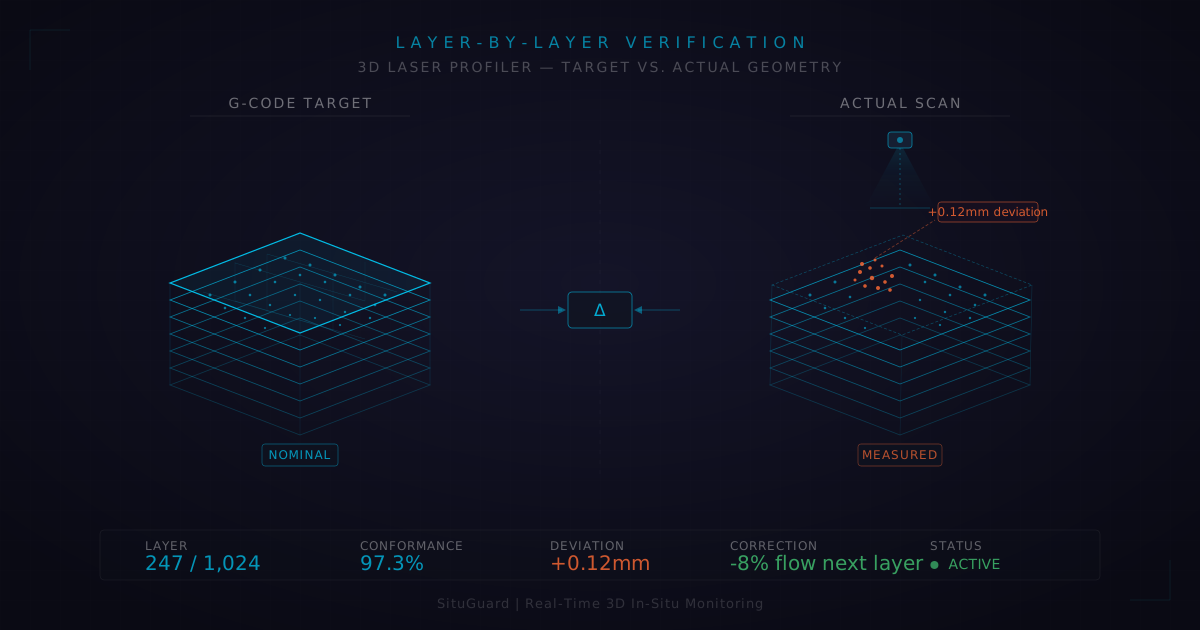
The 3D laser profiler is particularly central to the feedback loop. After each layer is deposited, the profiler scans the surface and generates a dense 3D point cloud representing the actual geometry of the printed layer. This measurement is compared against the reference geometry derived from the G-code. Before production begins, SituGuard performs material-specific calibration runs that characterize how a given material behaves under actual thermal conditions inside the build chamber — capturing shrinkage rates, crystallization behavior, and thermal gradients that would otherwise go undetected. These calibration profiles feed directly into the closed-loop control, so the system knows what to expect and how to compensate from the very first layer.
SituGuard, the real-time monitoring and control software, processes this sensor data and performs the comparison between actual and target states. When deviations exceed defined thresholds — whether in layer height, extrusion volume, surface topology, or thermal conditions — SituGuard generates corrective commands that are sent directly to the printer’s control system. Parameters such as extrusion multiplier, print speed, or temperature setpoints can be adjusted layer by layer.
The result is adaptive process control: the printer responds to what is actually happening, not just what was planned. If a region is slightly under-extruded, the system compensates on the next pass. If thermal conditions drift, parameters adjust accordingly.
Beyond Correction: Traceability and Digital Twins
Closed-loop control delivers more than just better prints. Every sensor reading, every deviation detected, and every correction applied is logged and stored. This creates a complete digital record of the manufacturing process — a digital twin of the build — that can be used for quality documentation, process validation, and regulatory compliance.
For industries like aerospace and medical device manufacturing, where traceability is a regulatory requirement, this capability is not optional. It is a prerequisite for using FFF as a production technology rather than a prototyping tool.
Implications for Industrial Adoption
The gap between open-loop and closed-loop FFF is not incremental. It is the difference between a technology that requires constant operator supervision and post-process inspection, and one that can function as a reliable, autonomous manufacturing process.
Open-loop printers will continue to serve prototyping and non-critical applications well. But for manufacturers who need repeatable, traceable, production-grade parts from FFF, closed-loop control is the enabling technology. It addresses the core limitations — repeatability, geometric accuracy, process transparency — that have historically kept FFF out of certified production workflows.
The question is no longer whether closed-loop control is necessary for industrial FFF. It is how quickly the industry will adopt it as the standard.
Want to learn more about how closed-loop control and real-time process monitoring are transforming industrial 3D printing? Download our whitepaper: “Beyond Prototyping — Turning Extrusion-Based AM into a Data-Driven Production Process.”

