What 25+ Integrated Sensors Actually Do Inside the TrueFormer 600
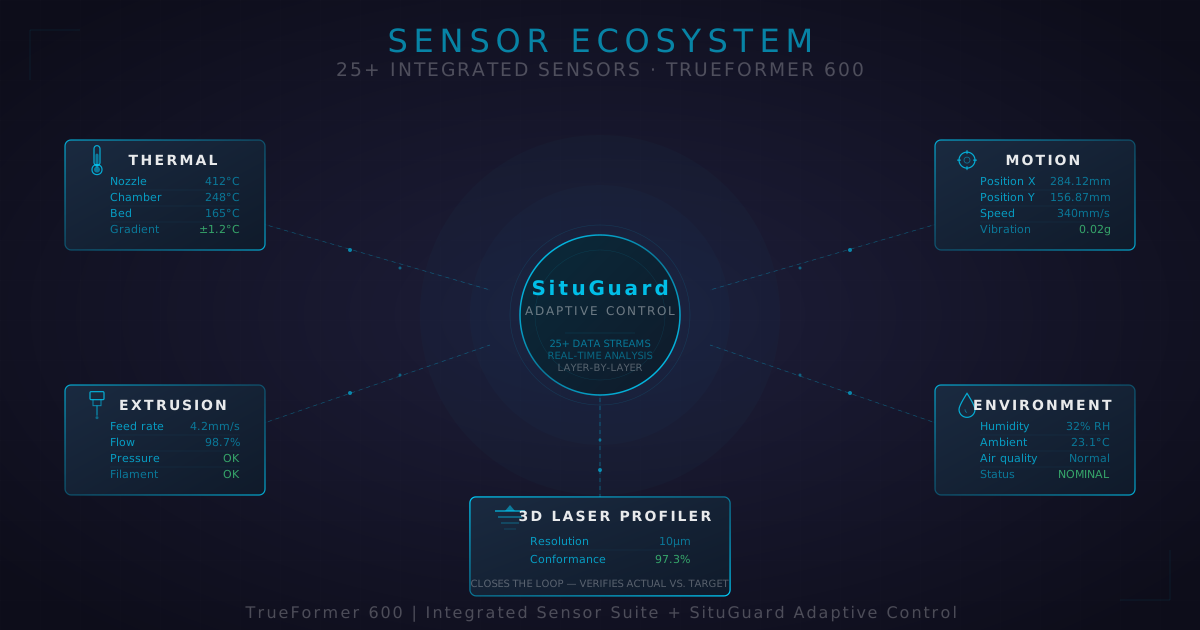
When we say the TrueFormer™ 600 has more than 25 integrated sensors, that number is not a marketing figure designed to impress. Every sensor in the system exists because it measures something that directly affects print quality — and because that measurement feeds into a closed-loop control system that can act on the data in real time.
This post walks through the major sensor categories, explains what each monitors and why, and shows how the data flows into SituGuard™ for adaptive process control.
Thermal Monitoring
Temperature is arguably the most critical variable in FFF. It governs polymer flow behavior, inter-layer adhesion, crystallization kinetics, warping, and dimensional accuracy. The TrueFormer 600 monitors temperature across multiple zones, not just at the nozzle tip.
Nozzle temperature is measured directly at the hotend, ensuring that the melt temperature matches the target for the material being processed. With a maximum nozzle temperature of 500 degrees Celsius, the TrueFormer 600 can process high-performance polymers like PEEK and PEI, where precise thermal control within a narrow processing window is essential.
Chamber temperature sensors are distributed across the build volume to capture the thermal environment surrounding the part. The TrueFormer 600 maintains chamber temperatures up to 250 degrees Celsius, which is necessary for semi-crystalline polymers that require controlled cooling rates to achieve target mechanical properties. Multiple sensors detect thermal gradients within the chamber — gradients that would otherwise cause differential shrinkage and warping across a part.
Bed temperature monitoring ensures consistent first-layer adhesion and manages the thermal interface between the part and the build platform. For materials that are sensitive to bed temperature variation, even a few degrees of deviation can mean the difference between a successful build and a warped or detached part.
Together, these thermal sensors provide a comprehensive picture of the temperature field at every stage of the build. If a heater underperforms, if airflow disrupts a temperature zone, or if a thermal gradient develops — the system knows.
Motion and Position Sensing
FFF is fundamentally a motion process. The quality of the printed part depends on how accurately the printhead follows the commanded toolpath. The TrueFormer 600 uses multiple sensors to verify positional accuracy.
High-resolution encoders on the motion axes provide continuous feedback on the actual position of the printhead and build platform. This allows the control system to detect and compensate for positional errors that can arise from mechanical backlash, belt stretch, or stepper motor skipped steps.
Endstop and reference sensors establish the machine’s coordinate system at the start of each build and enable the fully automatic calibration routine. Rather than relying on manual bed leveling — a common source of operator-induced variability — the TrueFormer 600 uses its sensor suite to calibrate itself, removing a significant source of print-to-print variation.
Vibration and acceleration monitoring captures the dynamic behavior of the motion system, particularly at the high speeds the TrueFormer 600 is capable of (up to 1000 mm/s). At these velocities, resonance and ringing artifacts become a real concern. Monitoring the actual dynamic response of the gantry allows the system to adapt acceleration profiles and print speeds to avoid excitation of resonant frequencies.
Extrusion Monitoring
Consistent material deposition is the foundation of part quality in FFF. The TrueFormer 600 monitors the extrusion process at multiple points along the material path.
Filament feed sensors track whether material is being supplied to the extruder as expected. They detect filament runout, tangles, or feed interruptions before these events result in failed layers. The dual direct drive extruder provides precise filament grip and feed, and the associated sensors verify that commanded feed rates match actual material movement.
Extrusion pressure and flow monitoring provides insight into what is happening inside the hotend. Variations in melt pressure can indicate partial clogs, inconsistent filament diameter, or changes in material viscosity due to moisture absorption. By monitoring these variables, the system can detect extrusion anomalies that would otherwise go unnoticed until they manifest as visible defects.
This is particularly valuable for long-duration builds. A partial clog that develops gradually over several hours may not be apparent from visual inspection of individual layers, but pressure trend data reveals the problem clearly.
Environmental Sensors
Material extrusion is sensitive to ambient conditions in ways that are often underestimated. The TrueFormer 600 monitors the environment both inside and outside the build chamber.
Humidity sensors are critical because many engineering thermoplastics — particularly nylons and polycarbonates — are hygroscopic. They absorb moisture from the air, and that moisture causes steam formation during extrusion, leading to bubbling, poor surface finish, and degraded mechanical properties. Monitoring humidity levels allows the system to flag conditions where material quality may be compromised.
Ambient temperature monitoring tracks the conditions in the room where the printer operates. Significant changes in ambient temperature affect the thermal balance of the build chamber, particularly during long prints. The system accounts for these variations when regulating chamber temperature.
The 3D Laser Profiler: Layer-by-Layer Verification
If the sensors described above monitor the process inputs — temperature, motion, extrusion, environment — the 3D laser profiler monitors the process output: the actual geometry of the printed part.
After each layer is deposited, the laser profiler scans the surface and generates a dense 3D point cloud of the as-built geometry. This measurement captures layer height, surface topology, extrusion width, and geometric accuracy with high resolution.
The point cloud is compared against the reference geometry derived from the G-code. Any deviation — whether it is a region of over-extrusion, an area where layer height is below target, or a geometric distortion caused by thermal stress — is detected and quantified.
This is the measurement that closes the loop. While the other sensors monitor whether the process is running within expected parameters, the laser profiler verifies whether the actual result matches the intended result. It is the difference between knowing the oven is at the right temperature and actually measuring whether the part came out correctly.
How the Data Flows Into SituGuard
Raw sensor data alone is not useful. What matters is how that data is processed, correlated, and acted upon.
SituGuard ingests the continuous data streams from all 25+ sensors and performs real-time analysis. It correlates thermal readings with extrusion data, compares laser profiler measurements against G-code references, and monitors trends over time. When deviations are detected, SituGuard determines the appropriate corrective action — adjusting extrusion multipliers, modifying temperature setpoints, adapting print speed — and sends commands directly to the printer’s control system.
This happens layer by layer, continuously, without operator intervention. The system also logs every measurement and every correction, creating a complete digital twin of the build process that serves as both a quality record and a dataset for process optimization.
Why Sensor Count Matters Less Than Sensor Integration
It would be straightforward to add sensors to any 3D printer. What is difficult — and what distinguishes the TrueFormer 600 — is building a system where sensor data is not merely collected but integrated into a coherent control loop. Each sensor feeds into a system that understands the relationships between process variables and part quality, and that can act on deviations in real time.
The 25+ sensors in the TrueFormer 600 are not individual instruments bolted onto a printer. They are components of a closed-loop manufacturing system, designed together to transform FFF from a hope-for-the-best process into one with the feedback, traceability, and adaptive control that industrial production demands.
Want to see how 25+ integrated sensors and closed-loop control work in practice? Schedule a consultation with our team to discuss your application.

